Intake and routing
Common problem
Fragmented intake and manual triage
Improvement focus
Structured requests, clearer ownership, faster routing, and fewer avoidable hand-offs.


IOVector helps service, operations, technology, data, and transformation teams turn AI ambition into controlled workflows: agents with clear boundaries, people in the right review points, trusted data access, and measurable operational outcomes.
Who IOVector helps
IOVector works best with service-heavy teams where workflow quality, operational visibility, control, and delivery speed all matter.
IOVector focuses on workflow problems where service quality, delivery speed, control, and accountability need to improve together.
Common problem
Fragmented intake and manual triage
Improvement focus
Structured requests, clearer ownership, faster routing, and fewer avoidable hand-offs.
Common problem
Approvals managed through email and spreadsheets
Improvement focus
Governed approval paths, defined escalation, and stronger evidence of who decided what.
Common problem
Disconnected systems, data, and operational reporting
Improvement focus
Trusted integrations, more useful workflow visibility, and outcomes that can be measured.
Explore practical solution areas shaped around the business problem, operating model, controls, and measurable outcome.

Agentic AI
Design AI agents that can classify, reason, recommend, escalate, and act inside governed enterprise workflows.
Explore this solution
Human + AI
Build workflows where AI handles repeatable work while people approve, review, and intervene at the right moments.
Explore this solution
Data + Integrations
Connect AI workflows to trusted enterprise data, applications, documents, APIs, and operational systems.
Explore this solutionThese anonymised examples are informed by prior enterprise delivery experience. They illustrate relevant workflow patterns and are not presented as named client endorsements.

Experience Pattern
Regulated operations team needing faster case progression without weakening controls, auditability, policy enforcement, or sensitive data handling.

Experience Pattern
High-volume customer operations team supporting service incidents and billing enquiries across multiple inbound channels.

Experience Pattern
Australian enterprise shared services function handling HR, IT, and finance requests through fragmented email, portal, and workflow channels.
How IOVector works
IOVector works with the systems and platforms clients already rely on, then designs the workflow boundary around the business outcome: what AI can do, what people approve, what data is trusted, and how the result is measured.
01
Map the current journey, queue friction, data gaps, hand-offs, controls, and the metric that should improve.
02
Define where AI assists or acts, where people review, which systems are involved, and how exceptions are handled.
03
Implement the workflow, connect the right platforms, test controls, and track operational outcomes through rollout.

Practical delivery partner
We are a consulting and delivery business focused on making AI useful inside real operating environments, with the discipline needed for enterprise workflows, governance, and adoption.
A practical delivery approach that brings together workflow knowledge, secure integration, measurable outcomes, and governance from the beginning.
Delivery model
Operating model, agent boundaries, and human review points
Define where AI should assist, recommend, act, escalate, and hand work back to people across enterprise operating workflows.
Trusted context, APIs, platforms, and reporting
Design how AI workflows connect to trusted data, APIs, workflow platforms, knowledge sources, reporting layers, and operational tools.
Controls, auditability, adoption, and measurable outcomes
Embed access controls, auditability, approval checkpoints, confidence thresholds, adoption plans, and measurable delivery governance.
Delivery capabilities
These describe how we design and deliver around client-approved platforms and operating environments without implying official third-party partnerships.
Trust signals
Articles for leaders evaluating agentic AI, human-in-the-loop workflows, secure integrations, governance, and practical automation.
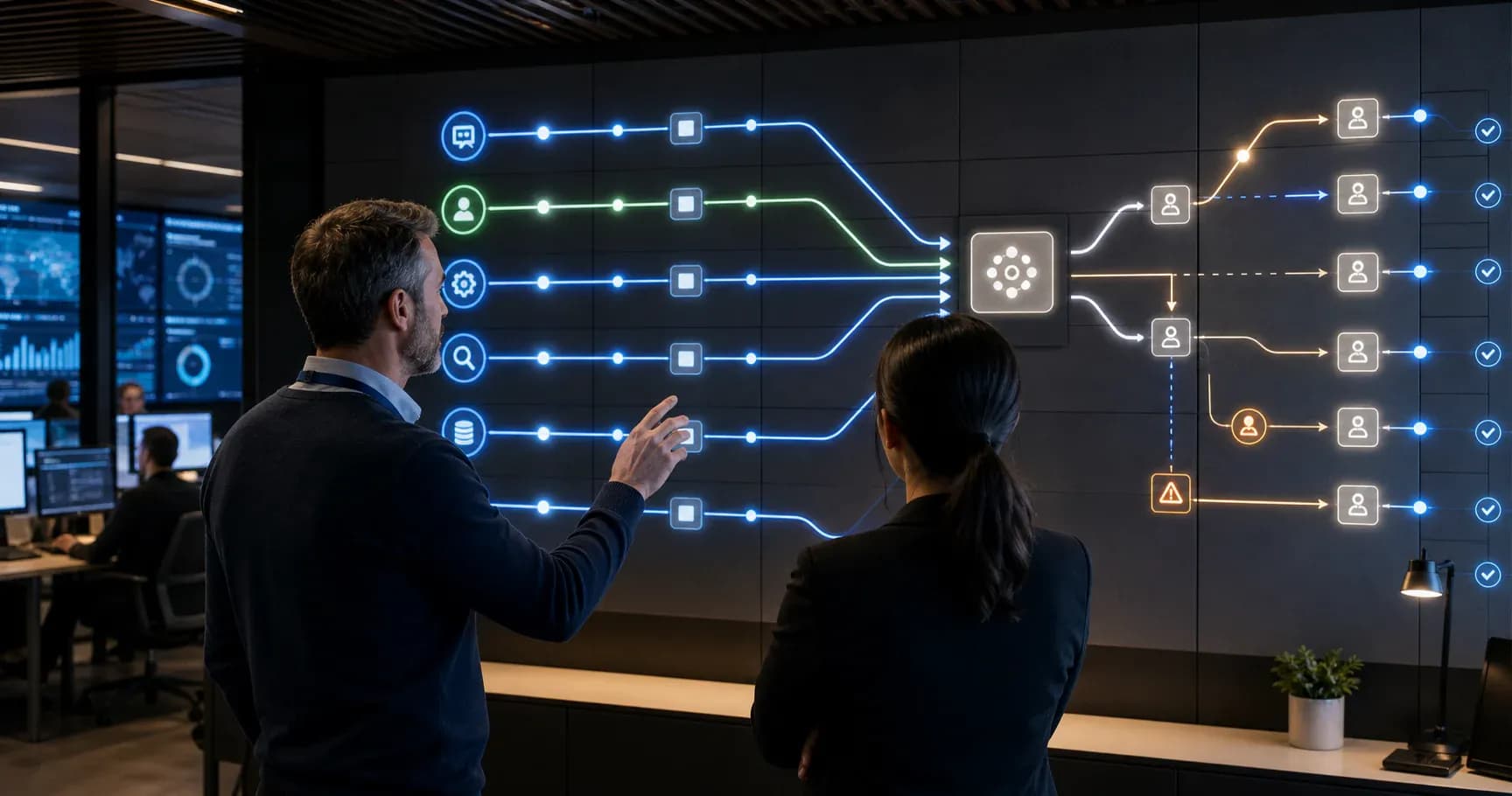
ServiceNow's agentic AI direction points to a bigger shift: enterprise AI agents need workflow context, permissions, orchestration, and governance before they can safely act.

Workflow platform strategy
18 June 2026

A practical explanation of how AI agents, human decision points, data, systems, and governance controls work together in production workflows.

Agentic AI strategy
15 April 2026

A practical IOVector article on scaling AI agents, human-in-the-loop workflows, secure integrations, governance, and measurable outcomes.

Agentic AI strategy
15 April 2026
Alongside governed AI consulting, IOVector builds and operates standalone products you can use directly.
An IOVector product
A secure website agent that gives visitors useful answers from content you approve, cites its sources, and stays within boundaries you control.
Status: Available
Visit Mr C→Start with the workflow
Tell us where work is slow, difficult to govern, or held together by manual hand-offs. We will help define a practical next step.